
In Summary
Due to changes from the WiscWeb hosting service and their move to WiscWeb 2.0, the CALS Web Service needs to make significant changes to our CALS web hosting service. Going forward we will only host collegiate, departmental, administration, center, and academic program sites on a new, leaner CALS Web Service 2.0, and must upgrade these sites to the CALS v4 theme. Current CALS hosted lab and project sites will migrate to the no-cost campus WiscWeb 2.0 service using the UW Theme 2.0. The External Relations web team will assist with theme and infrastructure migrations in phases and will notify site owners/editors when it is time for their site to migrate.
This change will require us to move all existing CALS hosted websites to new server infrastructure before the current CALS infrastructure is deactivated on June 30, 2027.
Our CALS website migration is separate from the WiscWeb migration process that is also underway. If you have a website on WiscWeb in the UW Classic theme, then you should follow their migration instructions and meet the completion deadline that they have set for December 2026.
Table of Contents
Quick Links
The information on this page is relevant only to sites hosted on CALS Web Service. Please make sure your site is hosted on our platform—not WiscWeb—before continuing.
If your site is hosted on WiscWeb, then you should follow their instructions and timeline for migrating your website before December 2026.
Why is this happening?
DoIT’s no-charge, campus-wide web hosting service, known as WiscWeb, is undergoing changes that will affect the CALS Web Service offered through the Office of External Relations. As concerns about cybersecurity, digital accessibility, other regulations, and maintenance have grown, WiscWeb has determined that they need to standardize and focus their services on their WiscWeb 2.0 platform.
This means they will no longer be able to host the CALS WordPress Web Service, which includes special CALS themes, features, and customizations.
When is this happening?
Our CALS Web Service team will be working through a list of 200+ websites to migrate in batches, based on department affiliation. Site owners/editors will be notified in advance to schedule a time block that works to suspend content editing while their site is migrated. This will begin in Summer 2026, and must be completed before June 30, 2027. We will reach out to each site owner in advance to communicate their timeline for website migration, and if needed, to also upgrade their theme. Please stay tuned for a communication for our team.
Please take a moment to designate your site’s primary contacts. It helps us more easily know who to contact when it is time for your site to migrate. Learn how to add primary contacts here.
What will happen to my site?
Depending on the type of site, it will be migrated to one of several supported web hosting services. At the time of migration, it may also need to be upgraded to the supported theme for hosting provider, either CALS v4 theme for CALS Web Service, or UW theme 2.0 for WiscWeb.
Each site migration may be a little bit different depending on several factors, including the site’s current theme, site type, and size/complexity (i.e. number of plugins, customized content, etc.). We have categorized all 200+ websites that are currently on our CALS Web Service, and have provided a tracking spreadsheet so every site owner/editor can look up their website.
Our CALS web team will help every step of the way and make sure sites will remain available with no downtime during this transition.
Planned Migration for CALS Hosted Websites
We will contact CALS site owners/editors in batches by department affiliation to communicate the steps we will take to migrate their website. Site owners will get a timeline for their transfer and detailed instructions on how to prepare and test sites before they go live.
Most sites will be migrated to one of the following web hosting services*
Moving to CALS Web Service 2.0
Collegiate, departments, centers, academic programs, research stations, and administration offices will continue to be hosted by CALS.
CALS Web Service 2.0 Migration Process
Included Sites
The following site types will be migrated to the CALS Web Service 2.0. If you’re not sure what your site type is, check the CALS migration progress spreadsheet (NetID required) to see where your site is going.
- Departmental
- CALS Administration and Offices
- Agricultural Research Stations (ARS)
- Academic Program sites
- CALS Centers
- Strategic College sites
Before Migrating
Our team will evaluate your site and determine if there is anything that needs to be done before we migrate to CALS Web Service 2.0.
- Ensure the site is active and necessary
If the site is no longer active or needed by its owner, we can archive it for later removal and/or download its contents. - Ensure the site is using the latest CALS v4 theme
If your site is not using CALS v4, we will work with you to upgrade your site to the new theme before migrating. To find the theme your site is currently using, refer to our site migration progress spreadsheet (NetID required) or find it listed in your admin dashboard. - Determine if the site is using any unsupported plugins
To improve performance and security, the new infrastructure has a reduced list of supported plugins. We will evaluate whether your site has any plugins that will no longer be supported and make a plan to retire their usage.
Migration Process
- The CALS Web Service Team will work with you to schedule your website migration.
- During the migration, you will be asked to withhold from editing any content on your site. Edits made to the old site after we begin the process will not be automatically brought over to the new site. Site owners/editors will be responsible for manually copying over any content changes made during the migration hold period.
- Our team will handle the technical details of transferring your site to the new server.
After Migration
Site owners/editors will be asked to check their site and will be able to edit your site as normal. You may notice subtle differences in speed, caching, and logging in. Please reach out to us if you have any issues or questions.
Moving to WiscWeb 2.0
Faculty lab/program, extension, and non-CALS sites that are currently hosted on CALS will be moved to WiscWeb, the no-charge, campus-wide web hosting service.
WiscWeb 2.0 Migration Process
WiscWeb is offered at no cost to campus programs.
Included Sites
The following site types will be migrated to WiscWeb 2.0 and its UW Theme 2.0. There are no costs to labs and project sites hosted by WiscWeb, and CALS External Relations staff will help each site owner with their website transition. If you’re not sure what your site type is, check the CALS migration progress spreadsheet (NetID required) to see where your site is going.
- Faculty Lab / Project sites
- CALS Extension-focused sites✝︎✝︎
- Non-CALS sites
✝︎✝︎ For those with Extension program content, you can choose to move your website to WiscWeb, or you may consult the Division of Extension website policies about the possibility of moving to the Division of Extension web hosting.
Before Migrating
Our team will evaluate your site and determine if there’s anything that needs to be done before we migrate to WiscWeb 2.0.
- Ensure the site is active and necessary
If the site is no longer active or needed by its owner, we can archive it for later removal and/or download its contents. - Determine if the site is using any unsupported plugins
To improve performance and security, the new infrastructure has a reduced list of supported plugins. We will evaluate whether your site has any plugins that will no longer be supported and make a plan to retire their usage.
Migration Process
- The CALS Web Service Team will work with you to schedule your website migration and transition your content to the new UW Theme 2.0 on the WiscWeb service.
- CALS web staff will partner with WiscWeb team at DoIT to support this transition.
- During the migration, you will be asked to withhold from editing any content on your site. Edits made to the old site after we begin the process will not be automatically brought over to the new site. Site owners/editors will be responsible for manually copying over any content changes made during the migration hold period.
After Migration
Your site content will be preserved, but may look a little bit different in the new UW theme 2.0. Once the site migration has been completed site owners/editors will be asked to check their site and will be able to edit your site as normal. Going forward, you will refer to WiscWeb documentation and contact WiscWeb for site support.
*In some cases, it may be recommended for a site to migrate to other web hosting options or archived depending on site affiliation and other factors. Through our audit we identified a number of websites that may be inactive or do not meet service eligibility requirements. During the migration process we will be asking these site owners whether the website is still needed, and as a result, some sites may be archived and removed, or migrated to other hosting options.
Site owners can also choose to pursue hosting through an outside vendor at the expense of their program. In this case, site owners must ensure their externally hosted sites meet all national and international regulations, governmental compliance, General Data Protection Regulation (GDPR), as well as comply with UW–Madison cybersecurity, branding and web accessibility standards.
Frequently Asked Questions
DoIT’s no-charge, campus-wide web hosting service, known as WiscWeb, is undergoing changes that will affect CALS web hosting services (CALS Web Service) offered through the Office of External Relations. As concerns about cybersecurity, digital accessibility, other regulations and maintenance have grown, WiscWeb has determined that they need to standardize and focus their services on their WiscWeb 2.0 platform. This means they will no longer support the underlying server infrastructure for the current CALS WordPress Web Service, which includes special CALS themes, templates, plugins, features and customizations on our own managed WordPress Multisite.
Changes to CALS Web Service
These changes have caused us to refocus the hosting services that we can offer to current CALS website clients through the CALS Web Service. Going forward, the CALS Web Service will operate at a smaller, more focused scale, and will provide direct support and hosting to collegiate administration, departmental, academic program and center sites. The college will host roughly 60 sites on a custom web hosting service provided by another division within DoIT that will allow us to continue to utilize our UW-Branded CALS designed theme (CALS v4 Block Theme), as well as our custom plug-ins and features that are beneficial to our collegiate websites. Staffing and other web hosting expenses will now be supported by External Relations.
These service changes will help us ensure that our future CALS Web Service will be able to continue to offer the high-level of support to the unique needs of college websites, and will also help to ensure a smooth and seamless transition for all other websites regardless of where they will be hosted going forward.
It depends which campus web service that your website is currently hosted on.
For Sites on CALS Web Service
Our CALS Web Service team will be take the lead to help our sites with their site migration. We will be working through our list of 200+ websites to migrate in batches, based on department affiliation. This will begin in Summer 2026, and must be completed before June 30, 2027. We will reach out to site owners/editors in advance to determine the timeline for your website migration. Please stay tuned for a communication for our team.
For Sites Already on WiscWeb Service
If your website is already hosted on the WiscWeb service, the site owner should work directly with WiscWeb to initiate and complete their website migration from WiscWeb Classic to WiscWeb 2.0. WiscWeb site owners are responsible for working directly with the WiscWeb team to migrate their websites before December 2026. The CALS Web Service team will not be assisting these website migrations.
There are about 100 CALS-affiliated websites already hosted on the WiscWeb Service. For any sites already hosted WiscWeb, you should remain being hosted on WiscWeb and follow the WiscWeb 2.0 migration process. You should plan to have your WiscWeb website migration completed before December 2026. WiscWeb has been sending out targeted communications to their site owners over the past academic year, and you may also contact the WiscWeb team if you have questions.
There are several ways to determine where your current website is hosted and what theme it uses.
For Sites on CALS Web Service
- Login and check the WordPress Admin dashboard for your website. If you see “CALS Web Service” at the top of the main dashboard page, then you are on CALS. The dashboard Site Info tile will also show the theme your site currently uses.
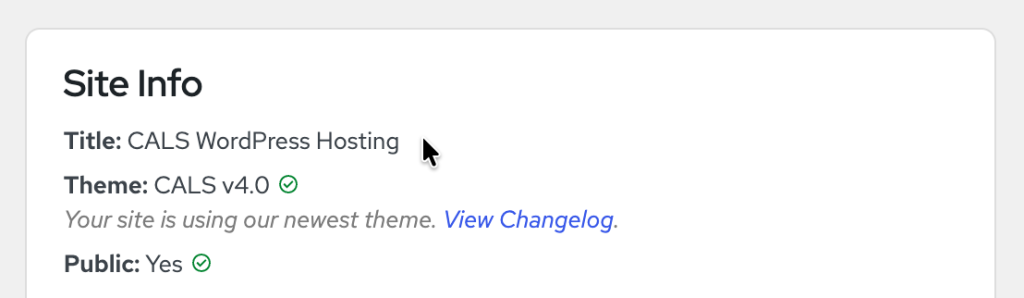
- You may also view our CALS migration progress spreadsheet (NetID required) to see if your website is hosted on CALS. It shows the site URL, title, current theme, and site type of all sites currently hosted by CALS. We will use this information to determine where your site will move to.
For Sites on WiscWeb Service
When logging into your website, all of the UW Theme Classic sites should show “My WiscWeb Sites” in the top left corner upon logging in (rather than just saying “My Sites”). If you see this, then your site is already hosted on WiscWeb and you are responsible for following the WiscWeb instructions for migrating your website to WiscWeb 2.0 before December 2026.

You can also look at the very bottom footer of the main page of your website for the following text:
“This site was built using the UW Theme Classic | Privacy Notice | © 2026 Board of Regents of the University of Wisconsin System.”
If you see this message, then your site is likely hosted on WiscWeb. In this case, you will want to remain on WiscWeb and follow the WiscWeb migration instructions to move your website to WiscWeb 2.0 and the UW Theme 2.0 before their deadline of December 2026.
If your website is already hosted on WiscWeb in the UW Theme Classic, then the site owner is responsible for migrating their own website to WiscWeb 2.0.
There are about 100 CALS websites hosted on the WiscWeb Service. For any sites already hosted WiscWeb, you should remain being hosted on WiscWeb and site owners are responsible for following the WiscWeb 2.0 migration instructions to move your website to WiscWeb 2.0 and the UW Theme 2.0 before their deadline of December 2026. WiscWeb has noted that any sites not migrated by that date will be removed in early 2027.
If you have any questions, you can reach out to either of our web teams since we are coordinating closely with each other during our separate migration processes.
This information only pertains to websites currently hosted on CALS Web Service.
The following categories of site types and their future planned campus web service platform are noted below. Please view our CALS migration progress spreadsheet (NetID required). It will show the sites that are hosted on the CALS Web Service, the theme it is currently using, where we are planning move the site during our migration. If you do not see your website on our list then it may be on WiscWeb, and you are responsible for working with them to migrate your website before their deadline. We have done our best to tag and categorize all sites, and we will continue to update the spreadsheet as we proceed through the migration process, and receive additional information about websites.
Site types that will remain on the new CALS Web Service (CALS v4 Theme)
- Departmental
- CALS Administration and Offices
- Agricultural Research Stations (ARS)
- Academic Program sites
- CALS Centers
Site types migrating to WiscWeb 2.0 Service (UW Theme 2.0)
- Faculty Lab / Project sites
- CALS Extension-focused sites
Exceptions: In some cases, it may be recommended for a site to migrate to other web hosting options or archived depending on site affiliation and other factors. Our audit identified a number of websites that may be inactive or do not meet service eligibility requirements. During the migration process we will also be asking some site owners whether the websites is still needed, and as a result, some sites may be archived and removed, or migrated to other hosting options.
Site owners can also choose to pursue hosting through an outside vendor at the expense of their program. In this case, the site owner will be fully responsible for their own migration and hosting setup and configuration. In addition, site owners must ensure their externally hosted sites meet all national and international regulations, governmental compliance, General Data Protection Regulation (GDPR), as well as comply with UW–Madison cybersecurity, branding and web accessibility standards.
The short answer is no. Due to accessibility, performance, and cybersecurity reasons, these themes will no longer be supported on the new CALS WordPress web hosting infrastructure and are not supported on the WiscWeb WordPress Web Service. Either way, if your site has not already migrated to one of the newer Gutenberg Block themes (CALS v4 theme for the CALS Web Service, or UW Theme 2.0 for the WiscWeb 2.0 Service), it will be required to do so during the migration.
The short answer is no. We have been working to drastically reduce the number of 3rd party plugins that are installed on our web service. Over the years, the CALS Web Service had ballooned to over 300 plugins. This is unsustainable and can lead to serious performance and security concerns. Over the past year, our team has begun the work of removing many of these plugins. We will continue the work of removing plugins, with the goal of removing 60-70% more in the next 12 months. We will maintain a small group of supported plugins to continue provide core functionality on CALS Web Service 2.0.
CALS Web Service has a plugin/feature request and review process that needs to be conducted before any plugin is added to CALS Web Service. We will also periodically review all existing plugins to ensure that they continue to meet our standards.
In additon, the WiscWeb Service has a list of supported plugins, and a feature request process.
You site will not lose content. However, if we need to upgrade your site from an older theme, it will visually look different, and since the newer campus supported themes (CALS v4 and UW Theme 2.0) utilize the improved Gutenberg block editor there are likely different ways of presenting the content you had previously in your old theme. Your site will look different because it will upgraded to different supported theme, and you will have a different/improved page editor to edit your pages.
There may be instances where we will need to sit down with a site owner to determine if a plugin will no longer be available on their future web service, and determine the best way that we can display their information, or replace the feature or functionality with something comparable in the new theme or a new block within the Gutenberg page editor. However, in some instances there may be not comparable feature replacement but this will mostly be in cases of very custom features or niche workflows such as the ability to add custom coding or css, where we can no longer support this for reasons due to cybersecurity, digital accessibility, UW branding concerns.
For example, some older non-gutenberg themes would use a third-party slider plugin to enable a slider/carousel feature. However in our new Gutenberg-based themes, the carousel/slider functionality is built right into the theme itself, so there is no longer a need for a separate plugin like rev slider.
Web hosting options and migration recommendations will be the same for these sites, but with the addition of some potential Division of Extension services.
Options for Extension-funded faculty and staff
- The best option for most lab websites is WiscWeb WordPress Service (no cost, campus supported web hosting)
- Those in the Extension Agriculture Institute should consider publishing content on Extension Agriculture websites rather than maintaining separate individual sites. The Agriculture Institute communications team can assist with posting content, keeping information current, and ensuring consistency across our web presence. Centralizing content on Extension Agriculture websites also helps improve search engine performance, enhances visibility in AI-powered search and discovery tools, and makes it easier for stakeholders to find accurate, up-to-date information. Contact the Agricultural Institute communications team for more information (NetID login required to access resource).
- In addition, extension-related website questions and requests can follow the division’s website policy.
- The Division of Extension Natural Resources Institute (NRI) provides fee-for-service options for designing websites and other marketing services. Note that they do not provide web hosting or long-term website maintenance as part of this service, so the site owner would be responsible for the long-term maintenance and web hosting through another service.
Other advanced options
These options are only viable in cases where a lab, project or program has dedicated IT staff that know how to manage web infrastructure, WordPress CMS instances, or are familiar with programming languages, html and css. These services are completely self-supported by the lab or program.
- DoIT Shared Web Hosting
Site owners are provided their own server space for a fee, and are expected to have technical staff to develop and maintain the WordPress instance, theme, as well as maintain the website content. - Dedicated Sever Hosting in CCI
This is an advanced fee for service option that provides a dedicated server on one of the campus cloud solutions.
Sites moving to CALS Web Service 2.0
Domains will not change as a result of migration. All domains will be supported in the new service.
Sites moving to WiscWeb 2.0
If you have a domain ending in wisc.edu, it will not change as a result of moving to WiscWeb 2.0. If your domain ends in .com, .org, or anything other than wisc.edu, those domains will not be directly supported in WiscWeb. Instead, you would have to redirect those domains to a wisc.edu domain. Refer to the WiscWeb Terms of Service and DNS changes announcement for more information.
Definitions
- CALS Web Service 2.0
The new server infrastructure that will host CALS department, center, academic programs, and administration sites. - WiscWeb 2.0
The central-campus web service available to UW-Madison departments, faculty, researchers and staff. It is recommended that lab and project sites currently hosted on CALS Web Service will be migrating to this service. - WordPress Theme
A WordPress theme controls the style and functionality of your site. Switching to a different theme often requires some manual work because features are not always consistent across different themes.- CALS 2015
The old CALS WordPress theme that will not be supported in CALS Web Service 2.0. - CALS v4
The newest CALS WordPress theme that supports the block editor. It provides strong UW–Madison branding and complies with digital accessibility standards, General Data Protection Regulation (GDPR), and other mandated requirements for university websites. - UW Theme Classic
The old/original WiscWeb WordPress theme that is not supported in WiscWeb 2.0. - UW Theme 2.0
The newest WiscWeb WordPress theme that supports the block editor. It provides strong UW–Madison branding and complies with digital accessibility standards, General Data Protection Regulation (GDPR), and other mandated requirements for university websites.
- CALS 2015
- Gutenberg/Block Editor
Used interchangeably, the WordPress Gutenberg/block editor is the newest way of creating content in WordPress. It uses blocks that you can add to your page to create content and layouts. Older themes likely used the classic or ACF-enabled (form-based) editors. - Migration
The process of moving a site from one server/platform to another. This could also include upgrading the site’s theme and removing unnecessary or unsupported plugins.